Chair Yoga When Your Chair Has Arms and Wheels
Quick Answer: A rolling swivel chair is not a safety problem if you lock the swivel by planting both feet flat and wide, and never load your weight into an armrest. Armrests block about a third of standard chair yoga poses - the fix is to use them as a support rather than working around them, and to substitute forward folds and open twists for the poses that need clear sides.
The irony of chair yoga is that the people who most need it are sitting in the one chair the videos were not filmed on.

Is a rolling chair actually safe for this?
Yes, with one non-negotiable rule: both feet flat on the floor, roughly hip-width or slightly wider, for the entire practice.
A five-star base with casters is very stable when weight is centered. It becomes unstable when weight moves toward one edge - which happens the moment you lift a foot, lean into an armrest, or twist while pushing off one leg.
Two additional checks worth 30 seconds. Sit down and try to spin the seat with your feet planted; if it turns easily, most chairs have a tension knob under the seat you can tighten. And roll the chair onto a mat or carpet rather than hard flooring - the friction difference is significant.
What to genuinely avoid: any pose that lifts both feet, any weight-bearing into the armrests, and standing up from the chair without holding something fixed. Those three cover essentially every reported chair yoga injury.
How do armrests change the poses?
They block lateral movement and they enable support. Both matter.
Blocked: side bends where the arm needs to travel down past the hip, seated figure-four where the ankle crosses wide, and any twist where you would normally grab the outside of the opposite chair edge.
Enabled: gentle chest openers where you rest both hands back on the armrests and let the sternum lift, supported forward folds where the forearms rest on the arms as you hinge, and wrist and forearm work with the elbow stabilized.
The useful reframe: an armrest is a prop, not an obstacle. A chair with arms is closer to a yoga chair with a backrest than to a dining chair, and traditional Iyengar chair sequences use exactly that support.
If your armrests are height-adjustable, drop them to their lowest setting before practice. That alone restores most of the blocked side bends.
What Nobody Tells You About Practicing at Your Desk
Three things that do not appear in the videos.
Your chair height is probably wrong for yoga. Desk height is usually set so your forearms are level with the keyboard, which often puts the seat higher than ideal. For chair yoga you want thighs parallel to the floor or slightly below, with feet fully flat. Drop the seat 2 to 3 inches before you start and put it back after.
The backrest recline is working against you. Most office chairs have a slight recline built in, which tips your pelvis backward and rounds your lower back - the exact posture you are trying to undo. Sit forward on the seat, away from the backrest, for anything involving spinal position.
Wheels move during transitions, not during poses. People brace for movement in the hold and get caught in the shift between poses. Move deliberately, one limb at a time.
That first point is the one that turns a mediocre session into a good one, and almost nobody adjusts for it.
What does a 6-minute desk sequence look like?
Feet flat, wide, seat lowered, sitting forward off the backrest.
- Seated cat-cow, 60 seconds. Hands on knees. Inhale, chest forward and up. Exhale, round the spine. Slow, about 5 seconds each direction.
- Armrest chest opener, 45 seconds. Hands back on both armrests, roll shoulders back and down, gently lift the sternum. Breathe. Do not push - the stretch should be mild.
- Seated twist, 45 seconds each side. Both feet planted. Hand on the opposite knee, other hand on the armrest behind you. Twist from the mid-back, not the neck.
- Supported forward fold, 60 seconds. Forearms onto the armrests or thighs, hinge forward, let the head hang. Come up slowly.
- Neck releases, 30 seconds each side. Ear toward shoulder, hand resting lightly on the head for weight only.
- Wrist circles and finger extensions, 60 seconds. Elbows on the armrests. Ten circles each direction, then open and close the hands slowly.
Six minutes, no standing, no floor, nothing anyone would notice from across an office.
When in the day should I do it?
The strongest evidence for movement breaks points at frequency over duration. Short breaks every 30 to 60 minutes outperform one long stretch session, particularly for the neck and lower back discomfort that desk work produces.
In practice, most people cannot break hourly. The next best pattern is three anchors: mid-morning, right after lunch, and mid-afternoon - the last one placed at whatever time your energy reliably dips.
The post-lunch one is worth prioritizing. Sitting immediately after eating is when people report the most stiffness later, and 3 minutes of gentle twisting and forward folding there tends to be the most noticeable.
One more practical trick: attach it to something that already happens. After you close a specific recurring meeting, after you refill your water, after a particular alarm. Habit research is consistent that anchoring to an existing cue beats scheduling by clock time.
FAQ: Office Chair Yoga Questions, Answered
Can I do this in a chair with no armrests?
Yes, and you get the side bends back. You lose the supported chest opener - substitute clasping your hands behind your back and gently drawing the shoulder blades together.
My chair sinks slowly. Is that a problem?
It is a mild one. A sinking gas cylinder means your hip angle changes mid-pose, which is more distracting than dangerous. Practice with a wall behind the chair for reference, or use a fixed chair for longer holds.
Should I take my shoes off?
If you can, yes. Feeling the floor through your feet improves your sense of where your weight is, which is the main safety variable in a rolling chair. Barefoot or socks with grip, not slippery socks.
TL;DR:
- Rolling chairs are safe if both feet stay flat and wide, and you never load weight into an armrest.
- Lower the seat 2 to 3 inches and sit forward off the reclining backrest before you start.
- Armrests block side bends and wide leg crossings, but enable supported chest openers and forward folds.
- A full sequence takes 6 minutes: cat-cow, chest opener, twists, forward fold, neck, wrists.
- Three short breaks beat one long session. Anchor them to something that already happens.
The chair you already sit in for eight hours is the right one to practice in. It just needs two adjustments before you start.
See It in Motion
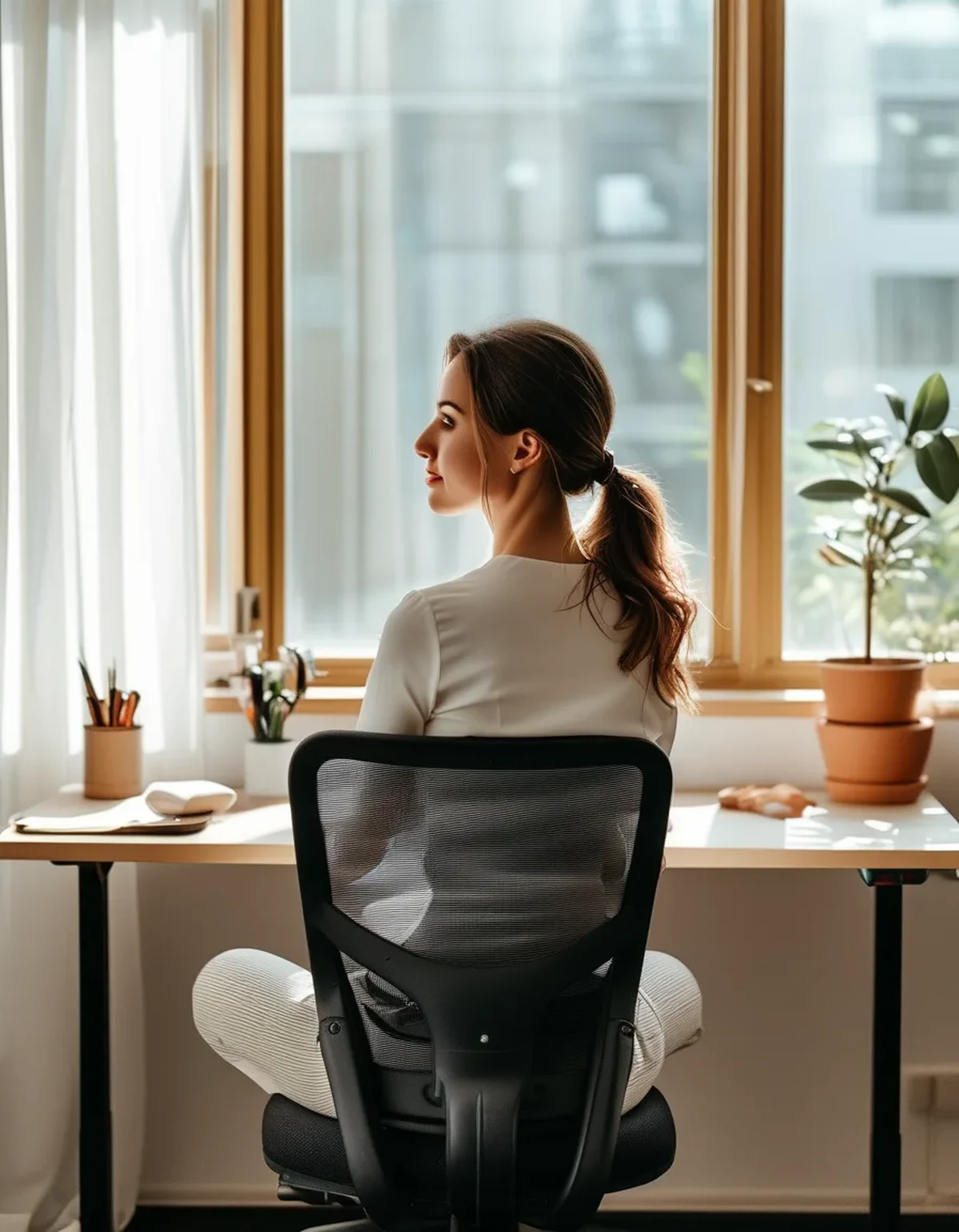
Seen here: High Waist Embossed Yoga Leggings with Side Pockets — shop it on bubblelime.com
Keep Reading
This article is for general informational purposes only and is not medical advice. Always consult a qualified health professional for guidance specific to you.