Chair Yoga for Shoulders That Round Forward at a Laptop
Quick Answer: Shoulders that round forward at a laptop are usually tight in front — chest and front-of-shoulder — rather than weak in back. Open the front for 60 seconds, then give the upper back something to do for 60 seconds. Twice a day beats one long session.
You notice it in a video call thumbnail. Your shoulders sit forward of your ears, your upper back is a soft curve, and pulling them back lasts about eleven seconds before they drift again.

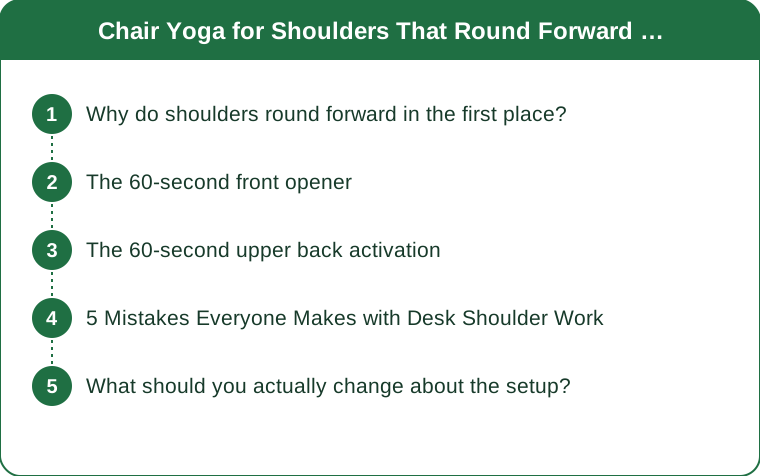
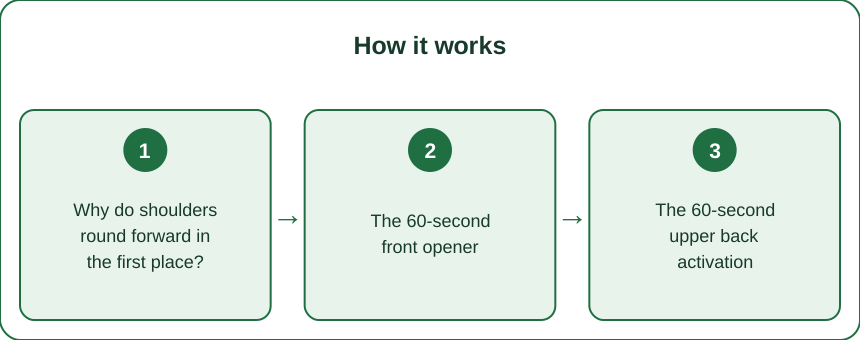
Why do shoulders round forward in the first place?
Sitting at a laptop puts your arms in front of you for hours. In that position, the chest muscles — pectoralis major and minor — and the front of the shoulder sit in a shortened range. Muscles adapt to the range they live in.
Meanwhile the muscles between your shoulder blades sit in a lengthened, low-effort position. They are not usually weak in any dramatic sense; they are just not being asked to do anything.
So the fix has two halves. Restore length in the front, then give the back a reason to hold. Doing only the second half is why pulling your shoulders back never sticks — you are asking a muscle to win a tug of war against tissue that has been shortening for six hours.
The good news is that this responds quickly. Not permanently in one session, but noticeably within a couple of minutes.
The 60-second front opener
Seated chest opener with the chair back. Sit forward so your shoulder blades clear the top of the backrest. Take your hands behind you, fingers interlaced or holding opposite forearms. Draw the knuckles down and away, and let the chest lift.
Hold 30 seconds, breathing normally. If your chair has arms, hold the far edges instead and lean the chest forward through them.
Doorway-style arm at the desk. Place one forearm vertically against the side of a doorframe, a wall, or the edge of a tall filing cabinet, elbow at about 90°. Turn your body slowly away from that arm until you feel a broad stretch across the front of the chest — not a pinch at the shoulder joint. Hold 20-30 seconds each side.
That is the whole first half. Under a minute if you move.

The 60-second upper back activation
Now give the back something to do. Order matters — do this after the openers, while the front has some new range.
Seated rows with no equipment. Sit tall, arms straight in front at chest height, palms facing each other. Pull the elbows back as though squeezing a tennis ball between your shoulder blades. Hold the squeeze 3 seconds, release. 10 reps.
Wall angels, seated version. Sit with your back flat against the chair back. Arms up in a goalpost, backs of the hands reaching toward the wall behind you. Slide them up as far as you can without the ribs flaring or the hands drifting forward. 8 slow reps.
Shoulder blade setting. Nothing but a squeeze and hold, 5 seconds × 5. Boring, and the one people skip.
5 Mistakes Everyone Makes with Desk Shoulder Work
1. Stretching only. Length without a reason to hold it fades by the next meeting. The activation half is what makes it last past lunch.
2. Pulling the shoulders back and down hard. Overcorrecting jams the shoulder blade into a fixed position. You want the blade free to move, not clamped.
3. Doing it once, for ten minutes. Two 90-second rounds spread across the day beats one long block, because the problem is accumulated position, not a single event.
4. Flaring the ribs. When the wall angel gets hard, most people arch the low back and push the ribcage forward. That fakes the range. Keep the ribs stacked over the hips and accept a smaller movement.
5. Ignoring the screen height. If the laptop is flat on the desk, you are re-creating the position within four minutes. A stack of books under it costs nothing and does more than any stretch.
What should you actually change about the setup?
Three adjustments, in order of how much they matter:
- Screen top at roughly eye level. This alone unloads the neck and stops the head-forward posture that pulls the shoulders with it.
- Elbows supported. If your forearms are unsupported, the shoulders carry the weight of your arms all day and creep upward. Armrests at the right height, or forearms resting on the desk edge, remove that load.
- Feet flat. A stable base lets the pelvis sit neutral, which lets the ribcage stack, which lets the shoulders sit back without effort. If your feet dangle, a box or a stack of reams fixes it.
Set a timer for every 45 minutes. Ninety seconds, twice a day minimum. This is general information, not medical advice — if you have sharp pain, numbness, or tingling down the arm, see a professional rather than stretching through it.
TL;DR:
- Rounded shoulders at a laptop are usually short in front, not weak in back — open the chest before you try to pull anything back.
- 60 seconds of front opening, then 60 seconds of upper-back activation. Order matters.
- Two short rounds a day beat one long session, because the cause is accumulated position.
- Raise the screen to eye level and support the forearms, or you rebuild the problem in four minutes.
None of this requires a mat, a change of clothes, or leaving your chair, which is exactly why it survives a working week. The version you actually do twice a day is worth more than the perfect twenty-minute sequence you do on Sunday.
See It in Motion
Seen here: Super High Waist Embossed Yoga Leggings with Inner Pocket — shop it on bubblelime.com
Keep Reading
This article is for general informational purposes only and is not medical advice. Always consult a qualified health professional for guidance specific to you.