5 Chair Yoga Poses That Actually Fix Tech Neck From Sitting All Day
Quick Answer: Tech neck - the forward-head posture from hours looking at screens - responds well to 5 specific chair yoga poses that target the front neck flexors, upper back, and chest: chin tucks, seated cat-cow, thread the needle, seated chest opener, and ear-to-shoulder stretch. A 5-minute daily routine, done consistently, tends to reduce discomfort within 2-3 weeks.
Your head weighs about 10-12 pounds, and every inch it juts forward toward a screen multiplies the strain on your neck several times over. These 5 chair yoga poses target exactly that pattern, and you can do all of them without leaving your desk chair.

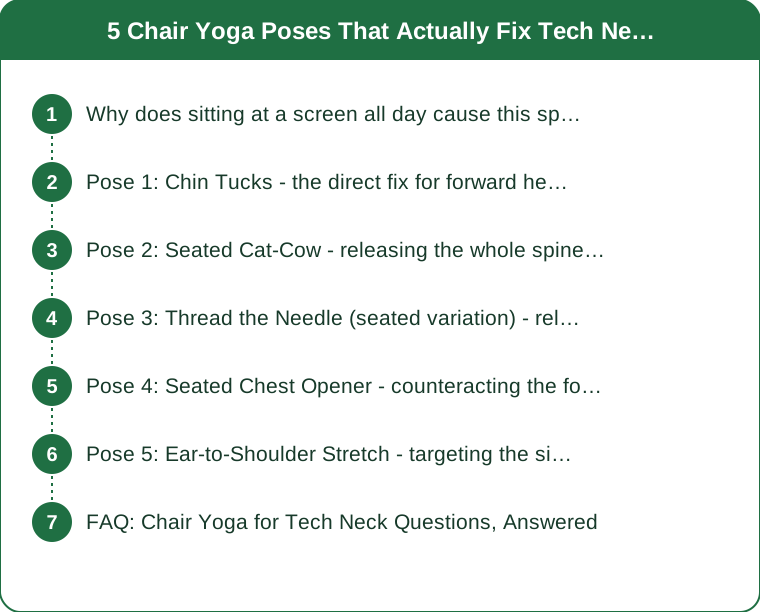
Why does sitting at a screen all day cause this specific kind of neck strain?
Forward head posture - where your head sits noticeably ahead of your shoulders instead of stacked directly above them - dramatically increases the load your neck muscles have to support. At a neutral position, your head’s weight is well-supported by your spine; tilted forward even 2-3 inches (a common amount for screen viewing), the effective load on your neck muscles can multiply several times over, according to commonly cited posture research.
This muscular strain, sustained for hours daily, leads to tightness in the front neck flexors and overstretched, weakened upper back and shoulder muscles - a specific imbalance that chair yoga poses targeting both sides of that pattern can address directly, rather than just generically stretching.
Pose 1: Chin Tucks - the direct fix for forward head posture
Sitting tall, gently draw your chin straight back, as if making a slight double chin, without tilting your head up or down. Hold for 3-5 seconds, then release, repeating 8-10 times. This directly retrains the muscles that pull your head back into proper alignment over your shoulders, counteracting the forward-jutting pattern screens encourage.
This is a small, subtle movement - if you’re moving your head up or down rather than straight back, the motion is too big and won’t target the right muscles.
Pose 2: Seated Cat-Cow - releasing the whole spine, not just the neck
Sitting toward the front edge of your chair, hands on your knees, alternate between arching your back and rolling your shoulders back (cow) and rounding your spine forward with chin toward chest (cat), moving slowly with your breath - inhale into cow, exhale into cat. Repeat for 8-10 full cycles.
Because tech neck rarely stays isolated to just the neck - it typically pulls the whole upper spine into a rounded pattern over time - this pose addresses the broader postural chain rather than just the neck in isolation.

Pose 3: Thread the Needle (seated variation) - releasing upper back tension
Sitting tall, reach one arm across your body and slide it under the opposite arm, letting your upper back and shoulder rotate and release, gently twisting your torso as you do. Hold for 20-30 seconds per side.
This targets the rhomboids and mid-back muscles that get chronically overstretched and weak from prolonged forward-head, rounded-shoulder sitting - releasing tension here often reduces the compensatory tightness that builds up in the neck as the upper back tries to support the imbalance.
Pose 4: Seated Chest Opener - counteracting the forward-rounded pattern
Interlace your fingers behind your lower back (or hold a strap if your shoulders are tight), gently lift your chest and roll your shoulders back and down, opening across the front of your chest. Hold for 20-30 seconds, breathing deeply into the stretch.
Tight chest muscles (pectorals) from hours of rounded, forward posture actively pull your shoulders forward, which worsens tech neck even when you’re consciously trying to sit up straight - this pose directly counteracts that pull.
Pose 5: Ear-to-Shoulder Stretch - targeting the side neck muscles
Sitting tall, gently tilt your right ear toward your right shoulder, using light hand pressure on the left side of your head if you want a deeper stretch (never pulling hard), holding for 20-30 seconds, then switching sides. Keep both shoulders relaxed and down throughout, rather than hunching up to meet your ear.
The muscles on the sides of your neck often carry compensatory tension from tech neck’s forward-and-down pattern, even though the primary strain is front-to-back - this pose addresses that side tension specifically, which the other four poses don’t directly target.
FAQ: Chair Yoga for Tech Neck Questions, Answered
How often should I do this routine for it to actually help?
Doing all 5 poses once daily is a reasonable starting point, and many people find splitting them into two shorter sessions (morning and afternoon) fits more naturally into a workday than one longer block.
How long before tech neck discomfort actually starts improving?
Most people notice some reduction in tension within 1-2 weeks of consistent daily practice, with more meaningful improvement in posture awareness and comfort by 3-4 weeks, though ongoing screen habits matter just as much as the stretching routine itself.
Should I stop if a stretch causes sharp pain, not just typical tightness discomfort?
Yes - mild tension release discomfort is expected, but sharp or shooting pain is a signal to stop and check with a physical therapist or doctor rather than pushing through it. This is general information, not medical advice.
TL;DR:
- Forward head posture from screen time multiplies the effective load on your neck muscles significantly
- Chin tucks directly retrain the muscles that pull your head back into alignment
- Cat-cow, thread the needle, and the chest opener address the broader upper back and shoulder pattern
- Consistency matters more than intensity - a daily 5-minute routine outperforms occasional longer sessions
This is general information, not medical advice - sharp or persistent neck pain deserves a professional look rather than relying on stretches alone.
See It in Motion
Seen here: Round Neck Long Sleeve Athletic T-Shirt — shop it on bubblelime.com
Keep Reading
This article is for general informational purposes only and is not medical advice. Always consult a qualified health professional for guidance specific to you.