Chair Yoga for Lower Back Pain: The 10-Minute Routine That Doesn't Require Getting on the Floor
Quick Answer: A 10-minute seated sequence of pelvic tilts, seated cat-cow, spinal twists, and a seated forward fold can meaningfully ease lower back tightness without ever getting on the floor — ideal for flare-up days or limited mobility.
Some days, getting down onto a mat and back up again is itself the thing that aggravates a bad back. Chair yoga removes that step entirely while still working through the same movements that actually help, and it takes only a chair you already own.

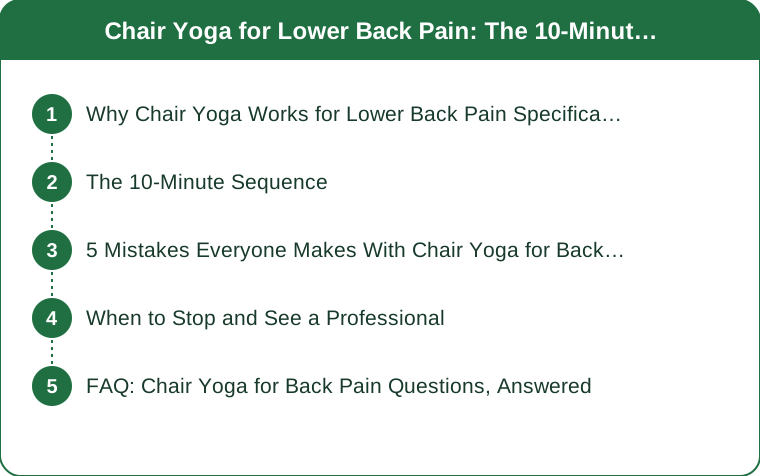
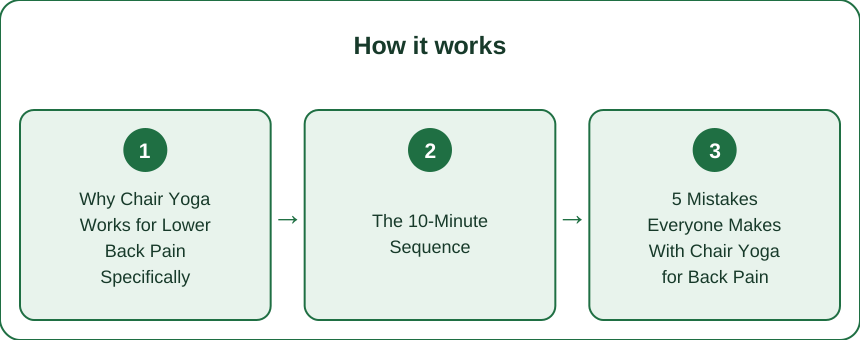
Why Chair Yoga Works for Lower Back Pain Specifically
Most gentle lower-back relief comes from small range-of-motion movements — tilting, rounding, twisting the spine slightly — rather than deep stretching, and a stable chair actually makes those small movements easier to control than an unsupported floor position where balance itself becomes part of the challenge. The chair’s back and seat also give you a fixed reference point to move away from and back to, which helps you feel exactly how much range you have on a given day, since that range genuinely varies day to day with a sensitive back.
The 10-Minute Sequence
1. Seated pelvic tilts (2 min): feet flat, hands on hips, rock the pelvis forward and back in a small controlled motion, 10 slow reps, focusing on feeling the movement happen in the lower spine rather than the hips. 2. Seated cat-cow (2 min): hands on knees, arch and round the spine with the breath, exhaling into the round, inhaling into the arch, 8 reps, moving slowly enough to feel each vertebra rather than rushing through the shape. 3. Seated spinal twist (2 min): one hand on the opposite knee, the other on the chair back, twist gently and hold 20-30 seconds each side, keeping the hips facing forward so the twist stays isolated to the spine. 4. Seated figure-4 stretch (2 min): ankle crossed over opposite knee, hinge slightly forward, hold 30 seconds each side to release the glute that often refers pain into the lower back, a connection that’s easy to miss if you’re only stretching the back itself. 5. Seated forward fold (2 min): feet wide, fold forward with a rounded spine, letting arms hang, hold 30-45 seconds, breathing steadily rather than holding the breath through the stretch.

5 Mistakes Everyone Makes With Chair Yoga for Back Pain
1. Rushing the pelvic tilts instead of moving slowly enough to actually feel each segment of the spine, which turns a therapeutic movement into a meaningless motion done on autopilot. 2. Skipping the figure-4 stretch, even though tight glutes are one of the most common referred sources of lower back tightness and often go completely unaddressed in a back-focused routine. 3. Forcing the twist further than feels natural — the goal is gentle rotation, not a deep stretch, and pushing past what feels comfortable can aggravate rather than relieve tension. 4. Doing the sequence only once during a flare-up instead of 2-3 short rounds spread through the day, which is often what it actually takes to keep acute tightness from building back up. 5. Holding the breath during the forward fold, which increases tension throughout the body instead of releasing it, defeating much of the purpose of the stretch.
When to Stop and See a Professional
Gentle seated movement is appropriate for general tightness and stiffness, but sharp pain, numbness or tingling down a leg, or pain that worsens with movement rather than easing are signals to stop and see a doctor or physical therapist rather than pushing through on your own. This is general information, not medical advice, and a back that doesn’t respond to a few days of gentle movement deserves a proper look rather than continued self-treatment.
FAQ: Chair Yoga for Back Pain Questions, Answered
How often can I do this sequence?
It’s gentle enough to do 2-3 times a day during a flare-up, or once daily as general maintenance — there’s no need to space it out like a strength workout, since the loads involved are minimal.
Do I need a special chair for this?
Any sturdy chair without wheels or arms in the way works — an office chair with a locked base is fine, but avoid anything that swivels or rolls during the twists, since an unstable base undermines the exact control the sequence is meant to build.
Will this actually fix chronic lower back pain?
It can meaningfully reduce day-to-day tightness and stiffness, but chronic or recurring pain deserves a proper evaluation to rule out a specific underlying cause — treat this as a relief tool alongside that evaluation, not a replacement for it.
Can I do this sequence at my desk without anyone noticing?
Most of it, yes — the pelvic tilts, cat-cow, and spinal twist are subtle enough to do at a desk between tasks without drawing attention, though the figure-4 stretch is more visible and works better saved for a moment with a bit more privacy.
TL;DR:
- A 10-minute seated sequence: pelvic tilts, cat-cow, spinal twist, figure-4, forward fold
- The chair gives a stable reference point that makes small controlled movements easier than the floor
- Don’t skip the figure-4 stretch — tight glutes are a common hidden contributor to back tightness
- Repeat 2-3 short rounds through the day during a flare-up rather than one long session
- Sharp pain or leg numbness means stop and see a professional, not push through
On days when the floor feels like one obstacle too many, this sequence gets you the same relief sitting exactly where you already are.
See It in Motion
Seen here: Bootcut Capri Yoga Pants with Pockets — shop similar styles on bubblelime.com
Keep Reading
This article is for general informational purposes only and is not medical advice. Always consult a qualified health professional for guidance specific to you.