Chair Yoga for the Stiffness That Arrives When the Weather Cools
Quick Answer: Joint stiffness in cool weather comes mostly from reduced tissue temperature and slower synovial fluid movement, not from damage. Warm tissue moves better, and movement itself is what warms it - which is why the first ten minutes are the hardest and the fix is to start smaller rather than to push harder. A 10-minute seated sequence done before you stand up handles most of it.
The stiffness that shows up around now is real and it is annoying, and it is also one of the most responsive problems in the body. It changes within minutes of the right kind of movement, which is not true of very much.

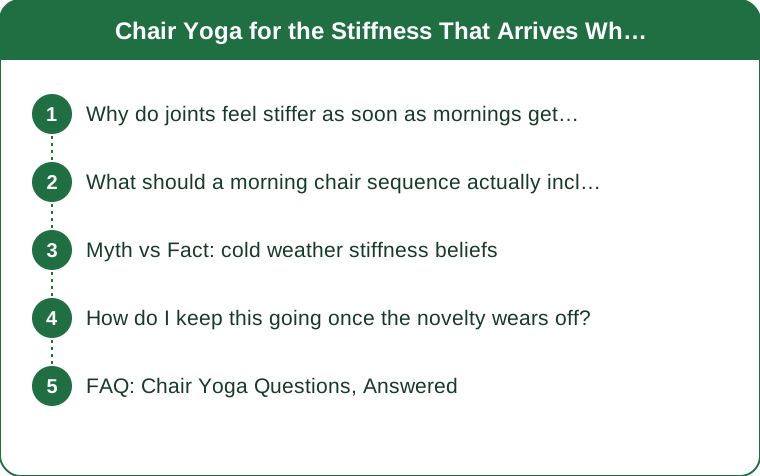
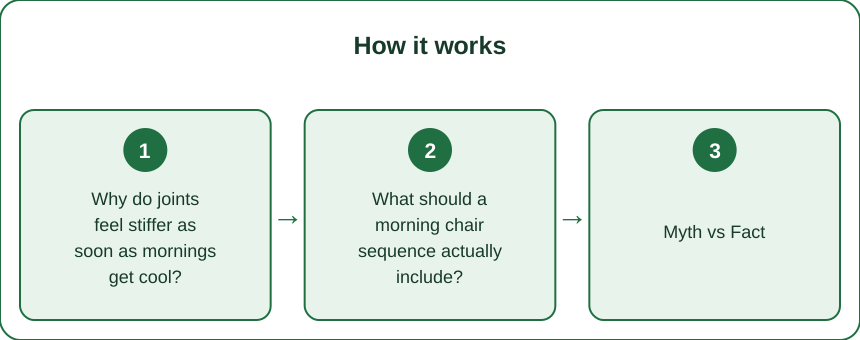
Why do joints feel stiffer as soon as mornings get cool?
Three mechanisms, none of which involve anything being wrong with you.
Tissue temperature drops. Muscle, tendon, and fascia are all viscoelastic - their resistance to stretch depends on temperature. Cooler tissue is stiffer tissue, in a straightforward physical sense. A muscle a few degrees cooler genuinely requires more force to lengthen and feels tighter at the same range.
Synovial fluid gets more viscous. The fluid that lubricates your joints thins with movement and warmth and thickens with cold and stillness. After a night of both, it is at its most viscous, which is exactly why the first few steps in the morning feel like the worst moment of the day.
You move less. As it gets cooler and darker, incidental movement drops - shorter walks, less time outside, more time in a chair. Reduced daily movement volume compounds everything above, and it happens gradually enough that most people do not connect it to the stiffness.
There is a fourth factor worth naming for anyone with arthritis: many people report weather-related symptom changes, and while the research on barometric pressure is genuinely mixed, the temperature effect on tissue is well established. This is general information, not medical advice - persistent or worsening joint pain is worth a professional conversation.
What should a morning chair sequence actually include?
Work from the spine outward, and keep every movement small at first.
1. Seated breathing and rib expansion - 1 minute. Sit with both feet flat, hands on the sides of your ribs. Breathe in and feel the ribs widen sideways. This is not a formality; it warms the deep trunk muscles and it tells you where you are holding tension today.
2. Neck releases - 2 minutes. Ear toward shoulder, hold 20-30 seconds each side, then slow half-circles from one shoulder to the other, chin down. Never roll the head backward.
3. Seated cat-cow - 2 minutes. Hands on knees. Inhale, arch gently and lift the chest. Exhale, round the back and drop the chin. Eight to ten rounds, slow. This is the highest-value movement in the sequence because it mobilizes the whole spine in both directions with almost no load.
4. Seated twist - 2 minutes. Hand on the opposite knee, other hand on the chair back or seat. Turn from the mid-back rather than pulling with the arm. Hold three breaths each side, twice.
5. Ankle and wrist circles - 1 minute. Ten each direction. These joints stiffen overnight and are easy to skip.
6. Seated figure-four - 2 minutes. Ankle across the opposite knee, sit tall, hinge slightly forward until you feel the outer hip. Hold 30 seconds each side.
Ten minutes total. The order matters more than the perfection of any individual movement.

Myth vs Fact: cold weather stiffness beliefs
Myth: stiffness in the cold means your joints are wearing out. Fact: temperature-related stiffness affects people of every age and joint condition, including people with entirely healthy joints. It reflects tissue mechanics and lubrication, not damage. Damage does not appear and disappear within ten minutes of movement.
Myth: you should stretch harder when you feel stiffer. Fact: cold tissue is less compliant and more easily strained. Stiffer mornings call for smaller ranges and more repetitions, then greater range once warm. Forcing range into cold tissue is the main way a stiff morning becomes an injured week.
Myth: chair yoga is only for people who cannot do real yoga. Fact: seated work removes the floor transition, which is the single biggest barrier for many people - and it makes spinal mobility work far more accessible to do daily. A sequence you do every morning beats a mat practice you do twice a month. Plenty of people use both.
Myth: you need heat before you can move. Fact: a hot shower feels good and does help superficially, but movement produces heat in the tissue itself, which reaches deeper and lasts longer. Move first, then shower if you like - or do the sequence in the shower’s warmth if that helps you start.
Myth: if it does not hurt, it is not doing anything. Fact: mobility work operates well below pain. The target sensation is a mild stretch you could hold and talk through. Pain is a signal to reduce range, not a measure of effectiveness.
How do I keep this going once the novelty wears off?
Attach it to something you already do without deciding, and make the minimum absurdly small.
Anchor it. The sequence works best attached to an existing morning fixture - while coffee brews, immediately after sitting down at a desk, right after you get out of bed. An anchored habit survives; a scheduled one competes with everything else.
Set the floor at two minutes. On a bad morning, do the breathing and the cat-cow and stop. The whole value of a daily practice is the daily part, and a two-minute version protects the streak far better than an all-or-nothing ten-minute rule. Most days the two minutes becomes ten anyway once you have started.
Use the same chair. A sturdy chair without arms, feet flat on the floor, ideally the same one every day. Environmental consistency does a surprising amount of the remembering for you. If your feet do not reach the floor comfortably, put a book or a folded towel under them - unsupported feet make every seated movement less stable.
Track it in the crudest possible way. A mark on a calendar. Not an app, not a log with details. The friction of tracking is what kills tracking.
Expect the benefit to be cumulative and undramatic. Most people notice the difference not in how the sequence feels but in how the rest of the morning goes - getting out of the car, going up stairs, reaching into a cupboard. That is the actual return, and it arrives after a couple of weeks rather than on day one.
FAQ: Chair Yoga Questions, Answered
How long before I notice a difference?
Within a single session you should feel looser immediately afterward - that is the temperature and lubrication effect and it is genuine but short-lived. The durable change, where mornings simply start easier, generally takes two to four weeks of near-daily practice. If a month of consistent work produces nothing at all, that is worth mentioning to a professional rather than pushing harder.
Can I do this if I have arthritis or a joint replacement?
Many people can and do, and gentle seated mobility is frequently recommended - but the specifics depend on your situation, and joint replacements in particular come with movement restrictions that vary by procedure. Check with your own clinician about which ranges are appropriate for you before adding twists or deep hip work. This is general information, not medical advice.
Is a morning or evening sequence better?
Morning addresses the stiffness directly, which is why it feels more useful. Evening work has a different benefit - it reduces the accumulated tension of a day in a chair and may improve how you sleep, which affects how stiff you feel the next morning. If you can only do one, do the morning. If you can do a second, keep the evening one shorter and gentler.
TL;DR:
- Cool-weather stiffness comes from colder, less compliant tissue and thicker synovial fluid - not from damage.
- Move first: a 10-minute seated sequence of breathing, neck, cat-cow, twist, ankles and wrists, and figure-four covers it.
- Cold tissue needs smaller ranges and more reps, not harder stretching.
- Anchor the habit to an existing routine and set the floor at two minutes so bad days do not break the streak.
Stiffness that responds to ten minutes of gentle movement is telling you something reassuring about itself. As the mornings keep cooling through autumn, the sequence gets more valuable rather than less - and the version you actually do every day, in the same chair, while the coffee brews, is worth far more than the ambitious one you keep meaning to start.
See It in Motion
Seen here: Racerback Tank Top - White — shop similar styles on bubblelime.com
Keep Reading
This article is for general informational purposes only and is not medical advice. Always consult a qualified health professional for guidance specific to you.