Chair Yoga for the First Weeks Back at a Full Desk Schedule
Quick Answer: The stiffness that arrives in the first weeks back at a desk isn’t from sitting badly - it’s from a sudden increase in sitting volume after a more mobile summer. The tissues that complain first are the hip flexors, upper back, and neck extensors, in that order. Five to seven minutes of targeted chair movement, taken twice a day rather than once, addresses it better than a longer session at the end of the day.
Two weeks back at the desk and your neck feels like it belongs to someone else.
It’s a volume change, not a posture failure - and it responds quickly to the right five minutes.
This is general information, not medical advice. Pain that radiates into the arm, comes with numbness or weakness, or persists despite movement warrants seeing a doctor.

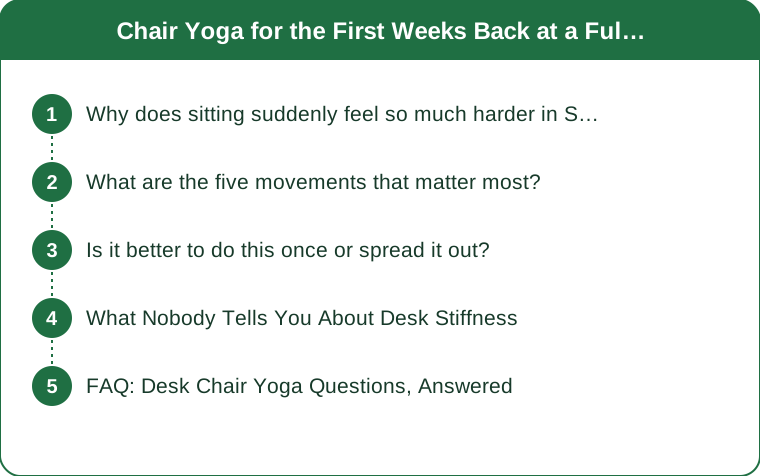
Why does sitting suddenly feel so much harder in September?
The change is in volume and variability, not in how you sit.
Summer schedules involve more incidental movement. Even a working summer typically includes more walking, more standing, more interruption, more being outside. Then September arrives and daily sitting time can jump by several hours in a single week with no transition period.
Tissue responds to change, not to absolute amounts. A person who sits six hours a day year-round is largely adapted to it. Someone who went from three to six in a fortnight is not - and the discomfort is an adaptation signal rather than damage.
Which tissues complain, in order:
1. Hip flexors. Held short for hours. Shortened hip flexors tilt the pelvis forward, which increases the arch in the low back - and low back ache is often really a hip flexor problem.
2. Thoracic spine. The upper back stiffens into flexion. Once the thoracic spine stops extending, the neck and shoulders take over the movement, which is where the next problem comes from.
3. Neck extensors. Holding the head forward against gravity for hours. Every inch the head sits forward of the shoulders substantially increases the load these muscles carry - which is why forward head posture produces such disproportionate fatigue.
The order matters because it tells you where to intervene. Treating the neck when the thoracic spine is the cause gives temporary relief and no lasting change. Address the hips and upper back, and the neck often settles on its own.
What are the five movements that matter most?
Roughly five to seven minutes, done seated, in this order.
1. Seated cat-cow, 8 slow rounds. Hands on knees. Inhale, arch, lift the chest; exhale, round, drop the chin. Move the whole spine, not just the low back. This is the general mobiliser - always first.
2. Seated thoracic extension over the chair back, 5 rounds, 5 seconds each. Sit tall against the backrest, hands behind the head, elbows wide, lean back gently over the top of the chair back, opening across the chest. This is the single highest-value movement of the five because it directly reverses the position the upper back has been stuck in. Stop at gentle stretch - no forcing.
3. Seated twist, 30 seconds each side. Feet flat, sit tall, turn from the mid-back and use the chair for gentle leverage, not to crank. Keep the hips facing forward.
4. Chin tucks, 10 reps, 3 seconds each. Draw the head straight back, making a double chin, without tipping it up or down. It looks like nothing and it directly trains the muscles that hold the head over the shoulders. Expect it to feel awkward and to be surprisingly tiring.
5. Seated figure-four, 45 seconds each side. Ankle across the opposite knee, sit tall, hinge forward from the hips until you feel the glute and outer hip. Addresses the hip side of the problem without standing up.
Add a standing hip flexor stretch if you can: stand, step one foot back, tuck the pelvis under, hold 30 seconds each side. This is the one thing you genuinely can’t do well seated, and it’s worth the 60 seconds.

Is it better to do this once or spread it out?
Spread it out, decisively.
Frequency beats duration for sitting-related stiffness. The problem is sustained position, and the fix is interruption. Two five-minute breaks are worth more than one ten-minute session, and three are better still.
A practical schedule:
- Mid-morning, around 10:30 - the full five-movement sequence
- Mid-afternoon, around 2:30-3 - repeat, and this one also lands in the natural alertness dip
- Optional 60-second version - cat-cow and chin tucks only, any time you notice the neck
The afternoon session does double duty. The mid-afternoon dip is a genuine circadian phenomenon, not just tiredness. Movement at that point improves alertness more reliably than another coffee, particularly after about 2pm when caffeine starts interfering with that night’s sleep.
Why end-of-day sessions underperform: by 6pm the tissue has been in the same position for eight hours. You get relief, and none of the prevention - and evening sessions are also the first to be skipped when the day runs long.
Anchor it to something that already happens. After a recurring meeting, when you refill water, at a set calendar alert. A movement break that depends on remembering is a movement break that stops happening in week two.
On the standing desk question: standing all day produces its own problems - it’s a different static position, not a solution to static positions. Alternating every 30-60 minutes is what actually helps, and the chair sequence is worth doing regardless of which desk you have.
What Nobody Tells You About Desk Stiffness
Five things that change the approach.
Posture matters less than movement. The idea that there’s one correct sitting position that prevents problems doesn’t hold up well. The best posture is the next one - varied positions over time beat any single perfect one held for hours.
Your chair setup can undo all of this. If the screen is below eye level, you’ll pull your head forward regardless of what you do at 10:30. The top of the screen should sit at or just below eye level, and feet flat on the floor or a footrest. Laptop users need either a stand plus separate keyboard or a permanent forward-head posture; there is no third option.
Water does more than hydration. The trip to refill is a movement break with a built-in reason. People who keep a small glass rather than a large bottle stand up several more times a day, which is a real and free intervention.
Eyes are part of the neck problem. Screen strain causes people to lean in, which drives the head forward. The 20-20-20 approach - every 20 minutes, look at something 20 feet away for 20 seconds - reduces the lean as well as the strain.
It usually settles in three to four weeks. The initial adaptation to increased sitting volume passes. If discomfort is still worsening after a month, that’s a different signal and worth having looked at rather than stretching through.
FAQ: Desk Chair Yoga Questions, Answered
How long until I feel a difference?
Most people notice looser movement within the first session and a meaningful reduction in daily stiffness within one to two weeks of consistent twice-daily breaks. Consistency matters far more than intensity here.
Can I do these in an open office without looking odd?
All five are subtle enough for most workplaces - seated twists, chin tucks and cat-cow read as ordinary shifting. If you’d rather not, the same sequence works in a meeting room or stairwell in three minutes.
What if my neck already hurts?
Stay gentle and stay within a comfortable range - chin tucks and thoracic extension are usually well tolerated. Pain that radiates into the arm, or comes with pins and needles or weakness, is a different problem and needs medical assessment rather than more stretching.
Do I need to stretch or strengthen?
Both, and the strengthening component is the one people skip. Chin tucks and thoracic extension are strengthening movements as much as mobility ones. Stretching alone gives temporary relief; adding strength is what makes it stick.
Is a standing desk better?
Better than sitting all day, not better than moving. Standing statically produces leg, foot and low back complaints of its own. Alternating positions every 30-60 minutes is the approach with the best support.
TL;DR:
- The complaint is a volume change, not a posture failure - sitting hours jumped suddenly in September
- Tissues complain in order: hip flexors, thoracic spine, then neck - treat the cause, not the loudest symptom
- Five movements: cat-cow, thoracic extension over the chair back, twist, chin tucks, seated figure-four
- Twice daily beats once - frequency interrupts the sustained position that causes the problem
- The afternoon session doubles as a better answer to the 3pm dip than more caffeine
- Screen height and a laptop stand undo or amplify everything else you do
The neck is usually complaining about the upper back. Fix that and the neck stops asking.
See It in Motion
Seen here: Round Neck Long Sleeve Athletic T-Shirt — shop it on bubblelime.com
Keep Reading
This article is for general informational purposes only and is not medical advice. Always consult a qualified health professional for guidance specific to you.