Chair Yoga for the Shallow Breathing You Do at a Desk Without Noticing
Quick Answer: Desk posture physically restricts the ribcage and the diaphragm, so breathing gets shallower and faster the longer you sit - and concentration on a screen makes people hold their breath without noticing. Four movements fix most of it: a seated side bend to open the ribs, a chest and shoulder opener to undo the forward round, a hands-on-ribs breathing drill to restore lateral expansion, and an extended exhale to settle the nervous system. Four minutes, twice a day, done at your desk without changing clothes.
You finish a focused hour and take one enormous involuntary breath. That’s your body correcting an hour of shallow breathing you never noticed doing.

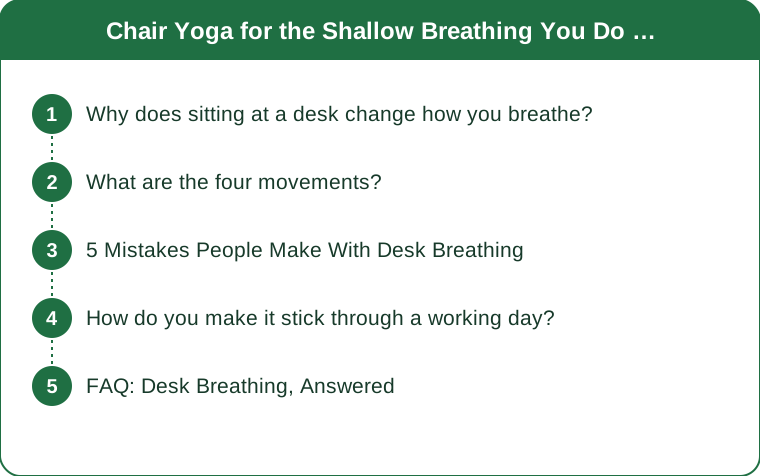
Why does sitting at a desk change how you breathe?
A rounded, forward posture physically limits ribcage movement. The ribs need to expand outward and upward to let the lungs fill fully. Slumped forward with shoulders rounded, that movement is mechanically restricted, so the breath gets smaller by default.
A compressed abdomen restricts the diaphragm. Sitting with a collapsed midsection leaves the diaphragm less room to descend, which is the main driver of a full breath. The body compensates by using neck and upper chest muscles instead - which is both less efficient and more tiring.
Focused screen work encourages breath holding. Many people unconsciously hold or shallow their breathing while concentrating, particularly while reading and typing. It’s common enough to have picked up nicknames, and the involuntary big breath afterwards is the giveaway.
Shallow chest breathing keeps you slightly activated. Faster, higher breathing is part of the body’s alert pattern, so hours of it can leave you feeling wired and tired at once, without any obvious cause.
And it compounds with everything else about desk posture. Neck tension, jaw clenching, and shoulder tightness all sit in the same pattern, which is why breathing work tends to relieve more than just breathing.
The first weeks back at a desk are the worst. After a summer of more movement, longer days, and less screen time, the return to full desk hours hits harder - and the breathing change is one of the earliest signs.
What are the four movements?
Movement one: seated side bend, both sides. Sit tall, feet flat, one hand on the seat beside you. Reach the other arm overhead and lean gently away from it, feeling the ribs on the stretched side open. Breathe into that side for three slow breaths, then swap. This directly restores the lateral rib expansion that sitting removes.
Movement two: seated chest opener. Interlace your fingers behind you, or hold the sides of the chair back, and draw your shoulder blades gently together while lifting your chest. Hold for five slow breaths. Keep the chin level rather than tipping the head back, and stop well short of any pinching.
Movement three: hands-on-ribs breathing. Place both hands on the sides of your lower ribs, thumbs to the back. Breathe in and try to push your hands outward rather than lifting your shoulders. Five to eight breaths. This is the drill that teaches the pattern; the hands give you feedback that thinking about it doesn’t.
Movement four: extended exhale. In through the nose for four, out for six or eight. Six rounds. The longer exhale is the simplest available way to shift toward a calmer state, and it works while you’re still looking at a screen.
Sequence order matters. Open the ribs, open the chest, then breathe - doing the breathing drill first, into a restricted ribcage, gives you much less to work with.
Total time is about four minutes. Short enough that it survives a busy day, which is the only quality that matters in a desk routine.

5 Mistakes People Make With Desk Breathing
Mistake 1: forcing a big breath. Trying to inhale as much as possible tends to recruit the neck and shoulders, which is the pattern you’re trying to leave. Aim for wider, not bigger.
Mistake 2: only breathing into the belly. Belly breathing is useful shorthand, but full breathing includes lateral rib expansion. Hands on the ribs teaches this in a way that a hand on the stomach doesn’t.
Mistake 3: doing it once and expecting it to hold. Posture and breathing pattern re-establish themselves within twenty minutes of going back to work. The value is in doing it repeatedly through the day, not perfectly once.
Mistake 4: waiting until you feel bad. By the time you notice fog and tension, you’ve had a couple of hours of the pattern. Anchoring the routine to a fixed time - after a specific meeting, on the hour - works far better than waiting for a cue.
Mistake 5: fixing the breathing and ignoring the setup. If your screen is low and your chair pushes you forward, you’re undoing the routine every time you sit back down. Raising the screen to roughly eye level is a one-time fix worth more than any exercise.
How do you make it stick through a working day?
Attach it to something that already happens. After a specific daily meeting, when you refill your water, before you open your inbox. Anchored habits survive; floating ones don’t.
Do the short version rather than skipping. Two side bends and six extended exhales is ninety seconds and covers most of the benefit. Having a short version is what prevents all-or-nothing skipping.
Use a standing version once a day. The same four movements standing, once in the afternoon, adds a postural reset that the seated version can’t provide.
Pair it with a screen break. Looking at something distant while you breathe handles eye strain at the same time, and gives you a reason to actually stop looking at the monitor.
Notice what changes rather than tracking it. Less jaw tension, fewer involuntary big breaths, a steadier afternoon. These are the signals that matter and they arrive within days.
And treat persistent breathlessness as separate. This is general information, not medical advice. Feeling short of breath at rest, breathlessness that’s new or worsening, chest pain, or dizziness are reasons to see a clinician rather than to do a breathing routine.
FAQ: Desk Breathing, Answered
Why do I breathe shallowly at my desk?
A rounded, forward posture mechanically restricts ribcage movement and compresses the diaphragm, so the breath gets smaller. Concentrating on a screen also makes many people hold their breath without noticing.
What is screen apnea?
It’s the informal name for the pattern of holding or shallowing your breath while concentrating on a screen. The big involuntary breath people take after a focused stretch is the most common sign of it.
How often should I do breathing exercises at work?
Short and frequent beats long and occasional - a four-minute routine twice a day plus a ninety-second version on the hour is more effective than one long session, because the posture re-establishes itself quickly.
Will fixing my breathing help the afternoon fog?
It often helps, because shallow chest breathing is part of a low-grade alert pattern that’s tiring to hold. It won’t fix sleep debt or a bad chair, both of which matter at least as much.
TL;DR:
- Desk posture physically restricts the ribcage and diaphragm, so breathing gets shallower the longer you sit.
- Concentrating on a screen makes many people hold their breath - the involuntary big breath afterwards is the tell.
- Four movements in order: side bend, chest opener, hands-on-ribs breathing, extended exhale. About four minutes.
- Aim for wider rather than bigger breaths, and keep a ninety-second version for busy days.
- Raise your screen to roughly eye level, or you’ll undo the routine every time you sit back down.
New or worsening breathlessness, chest pain, or dizziness is a clinician’s job, not a breathing routine’s.
See It in Motion
Seen here: Super High Waist Embossed Yoga Leggings with Inner Pocket — shop it on bubblelime.com
Keep Reading
This article is for general informational purposes only and is not medical advice. Always consult a qualified health professional for guidance specific to you.