Chair Yoga for the Tension You Carry in Your Face at a Screen
Quick Answer: Screen concentration produces a repeatable facial pattern: jaw clenched, brows raised or drawn together, eyes fixed at one distance, and breathing shallow through the chest. A four-minute seated sequence - jaw release, brow and temple softening, eye distance changes, and neck decompression - resets it. Do it twice a day rather than once, because the pattern rebuilds within about two hours.
Most desk routines address shoulders and hips and stop at the collarbone. That is a shame, because the face is where the concentration actually lives, and a tight jaw at 4pm is a headache at 7pm.

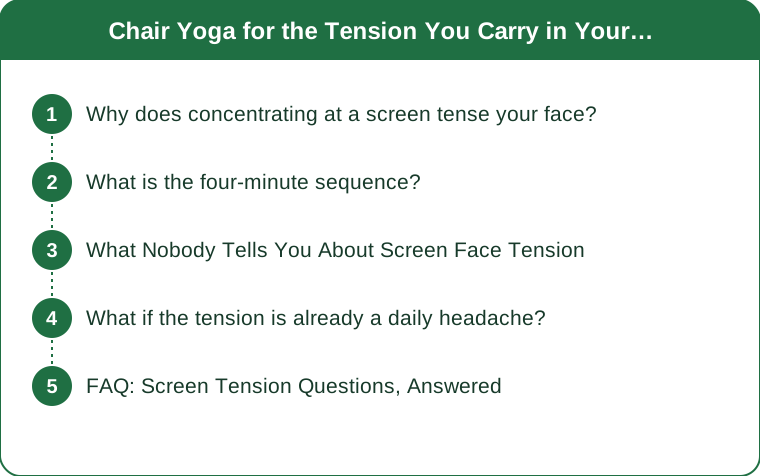
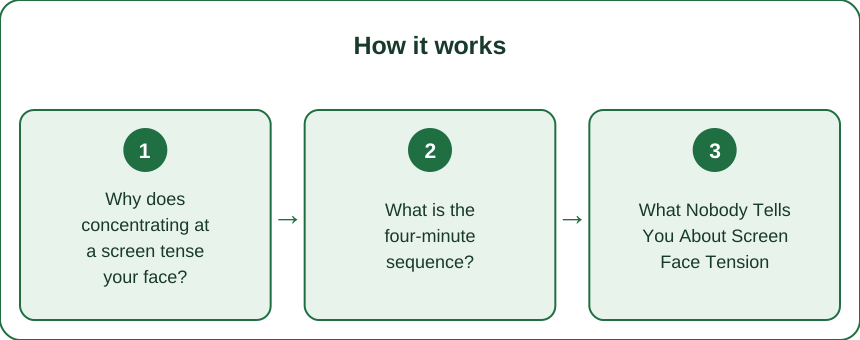
Why does concentrating at a screen tense your face?
Because focused attention recruits far more than your eyes, and none of it switches off on its own.
The jaw braces. The masseter is one of the muscles that engages during effortful concentration and mild stress. It is strong, it does not fatigue quickly, and it can hold a low-level contraction for hours without you registering it. That is why the ache arrives in the evening rather than during.
The brow and forehead work. Reading small text, squinting slightly at contrast, or simply concentrating produces frontalis activity - raised or drawn-together brows. Held for hours, this contributes directly to tension headaches across the forehead and temples.
The eyes stay at one focal distance. The ciliary muscle inside the eye holds a fixed accommodation for near work. It is a muscle sustaining a contraction, and like any muscle in that position it complains. This is most of what people call eye strain.
And the breath goes shallow. Concentration shifts most people into upper-chest breathing, and a subset hold their breath entirely during difficult moments - sometimes called screen apnoea. Shallow breathing raises overall muscle tension, which feeds back into the jaw.
Four systems, all driven by the same activity, all rebuilding within a couple of hours of resetting them. Which is why once a day does nothing and twice a day works.
What is the four-minute sequence?
All seated, all doable at a desk without anyone noticing much.
1. Jaw release - 60 seconds. Rest the tip of your tongue on the roof of your mouth just behind your front teeth. Let your back teeth come apart so there is a small gap, lips closed. Breathe in for four through the nose, out for six through slightly parted lips. Six rounds. This is the anatomical rest position of the jaw, and holding it makes clenching mechanically awkward.
2. Temple and brow softening - 60 seconds. Place your fingertips at your temples and make slow circles, ten in each direction. Then place three fingers on your forehead just above the brows and draw them outward toward the temples, slowly, five times. Finish by consciously letting the brows drop - most people discover they were holding them up.
3. Eye distance changes - 60 seconds. Look at something roughly six metres away for twenty seconds. Then something within arm’s reach for five. Then far again. Three rounds. Then close your eyes and cup your palms over them, no pressure on the eyeballs, for twenty seconds of complete darkness. This releases the accommodation the screen has been holding.
4. Neck decompression - 60 seconds. Sit tall, tuck your chin slightly back as if making a double chin - this decompresses the base of the skull. Hold five seconds, release, repeat three times. Then let the right ear travel toward the right shoulder, rest the right hand lightly on the left side of your head for gentle weight only, hold twenty seconds. Repeat left.
Timing: mid-morning and mid-afternoon. Setting a repeating alarm is not optional for most people, because the whole problem is that you do not notice the tension while it is building.

What Nobody Tells You About Screen Face Tension
The headache is usually referred, not local. Pain felt at the temples or behind the eyes frequently originates in the jaw muscles or the suboccipital muscles at the base of the skull. Treating the location of the pain does very little; treating the source often resolves it in a week.
Screen height changes jaw position. A laptop on a desk pushes the head forward and down, which alters the resting position of the jaw and loads the neck. Raising the screen so the top edge is at eye level does more for facial tension than any exercise on this list. Do that first, then do the sequence.
Glasses that are slightly wrong make everything worse. A prescription that is a year past its useful life produces constant micro-squinting, which is brow tension all day. If your face tension has got worse over the last twelve months and nothing else changed, an eye test is a reasonable first step.
Dry eyes drive squinting. Blink rate drops substantially during screen use - people blink roughly half as often. Less blinking means drier eyes means more squinting means more brow tension. Deliberate slow blinking, ten in a row, is a genuine intervention rather than a gimmick.
And the pattern is contagious across the body. A clenched jaw is very difficult to maintain with fully relaxed shoulders and an open chest. Working the face and the upper back together produces better results than either alone, which is why the neck decompression is in the sequence rather than treated separately.
What if the tension is already a daily headache?
Then the sequence is still worth doing, alongside a few structural changes and a realistic view of when to get it looked at.
Fix the setup before you fix the muscle. Screen top at eye level, screen an arm’s length away, text large enough that you are not leaning in, and a light source that is not behind the screen. Facing a bright window with a dim screen produces hours of squinting.
Use the 20-20-20 rhythm. Every twenty minutes, look at something about twenty feet away for twenty seconds. It is widely recommended because it works and because it is the only version of eye rest that people actually do.
Hydration and caffeine both matter here. Dehydration is a common headache trigger and desk work is where people stop drinking. High caffeine intake late in the day increases jaw clenching in many people.
Warm compress in the evening. Five minutes of a warm flannel over the jaw and temples before bed reduces overnight clenching for a lot of people, and it is the cheapest thing on this list.
And see a doctor or dentist if: headaches are becoming more frequent or more severe, your jaw clicks and locks or catches when opening, you wake with jaw pain most mornings, you notice teeth becoming flatter or newly sensitive, or a headache comes with visual changes, numbness, or weakness. Those need assessing rather than stretching. This is general information, not medical advice.
FAQ: Screen Tension Questions, Answered
Why does my jaw hurt after working at a computer?
Sustained concentration produces low-level clenching that you cannot feel while it is happening, because the jaw muscles tolerate long contractions without obvious fatigue. The ache typically arrives hours later.
Do eye exercises help with screen strain?
Changing focal distance genuinely helps, because near work holds the focusing muscle in a fixed contraction. The 20-20-20 rhythm and palming are the two with the most practical value.
How often should you do a desk reset routine?
Twice a day for a face and jaw routine, because the pattern rebuilds within about two hours. Short and frequent beats long and occasional for this particular problem.
TL;DR:
- Screen focus tenses jaw, brow, eye muscles, and breathing all at once.
- The four-minute sequence: jaw rest position, temple release, focal distance changes, neck decompression.
- Do it twice daily - the pattern rebuilds in about two hours.
- Raise the screen to eye level first; it does more than any exercise here.
Your shoulders get all the attention and your jaw does all the work. Four minutes, twice a day, is a fair trade for not having a headache at seven.
See It in Motion
Seen here: Super High Waist Embossed Yoga Leggings with Inner Pocket — shop it on bubblelime.com
Keep Reading
This article is for general informational purposes only and is not medical advice. Always consult a qualified health professional for guidance specific to you.